Performance Comparison: Engram vs. LoRA vs. LoRA+Engram
This document presents a detailed analysis comparing Engram-PEFT, LoRA (Low-Rank Adaptation), and the Combined (LoRA+Engram) mode using empirical data from engram_test8 and engram_test9 runs on NVIDIA RTX 4090D 24GB.
1. Metric Overview
The table below summarizes the key performance indicators from the 3000-step benchmarks using TinyLlama-1.1B on the TinyStories dataset (--batch_size 16, --grad_accum 2, --subset 30000).
| Metric | Base Model (Zero-shot) | LoRA (Baseline) | Engram (2 Layers) | LoRA+Engram | Full Finetune+Engram | Best Method |
|---|---|---|---|---|---|---|
| Eval Loss | 1.7401 | 0.9890 | 1.0165 | 0.9656 | 1.0944 | LoRA+Engram |
| Training Steps | - | 3000 | 3000 | 3000 | 3000 | - |
| Peak Allocated (GB) | 2.05 | 8.07 | 9.38 | 10.33 | 15.32 | LoRA |
| Peak VRAM (nvtop) | 2.91 GiB | 9.35 GiB | 10.82 GiB | 11.69 GiB | 16.80 GiB | LoRA |
| Avg Time/Step (s) | - | 0.2738 | 0.2961 | 0.3360 | 0.3818 | LoRA |
| GPU Utilization | - | ~100% | ~100% | ~100% | ~100% | - |
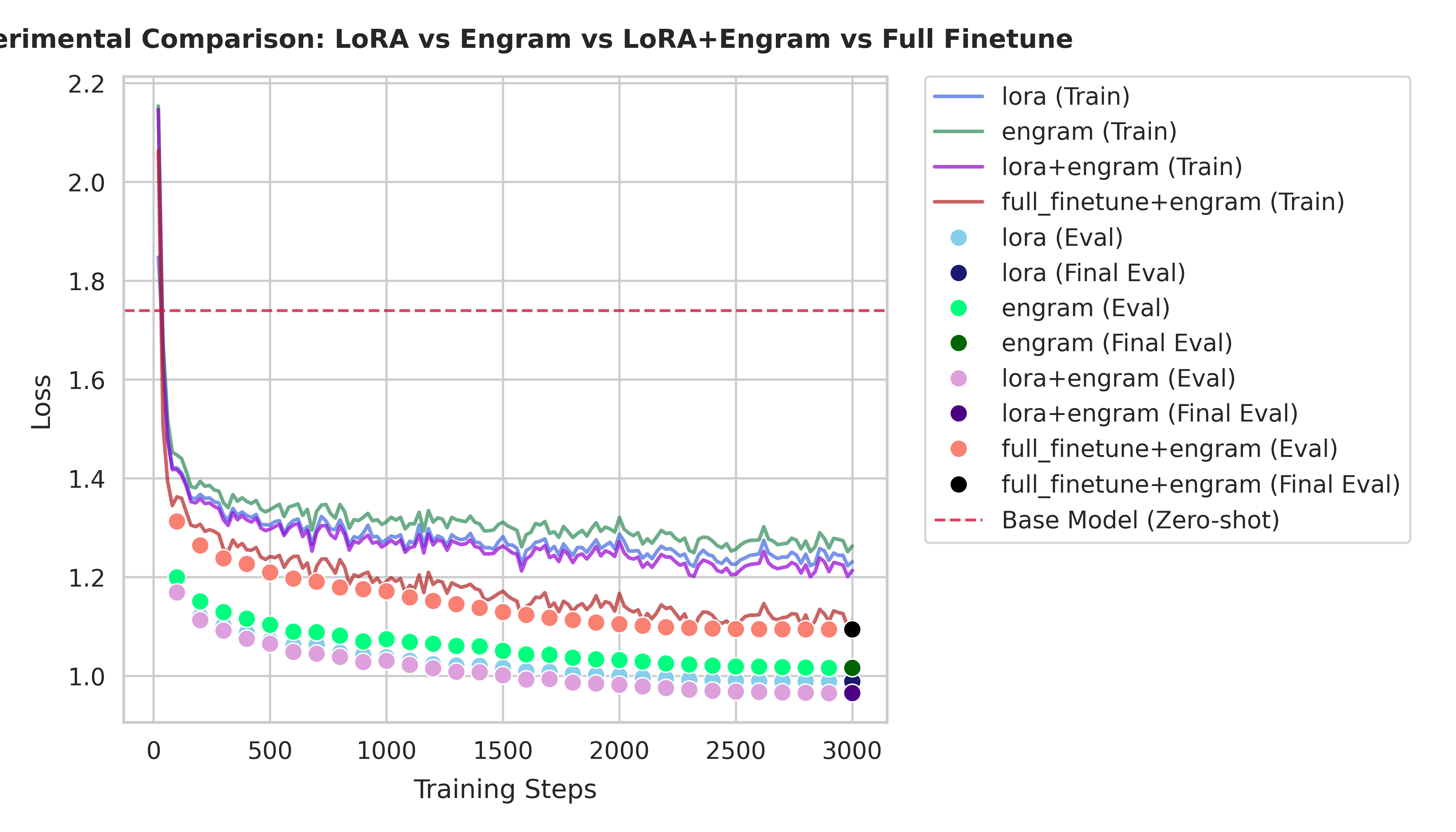
[!IMPORTANT] The LoRA+Engram method achieved the best convergence (lowest evaluation loss), outperforming standalone LoRA by 2.3%, Engram by 5.0%, and Full Finetune+Engram by 12.2%. This demonstrates the clear synergy between structural adaptation and sparse knowledge injection. Full Finetune+Engram, while more memory-intensive, shows competitive performance but requires significantly more GPU resources.
2. Memory Discrepancy Analysis
A common observation is that system-level monitoring (nvtop / nvidia-smi) reports higher VRAM usage than PyTorch's internal metrics (training_metrics.json).
Why nvtop is higher:
- CUDA Context Overhead: Initializing the GPU driver and context consumes a baseline of VRAM (~0.5 - 1.0 GB depending on the driver version).
- PyTorch Caching Allocator:
peak_memory_gbrecordstorch.cuda.max_memory_allocated(), which only counts active tensors. However, the PyTorch allocator keeps a pool of Reserved memory to speed up future allocations.nvtopshows this Reserved memory + Context memory. - Workspace Buffers: Operations like large GEMMs or cross-entropy loss gradients require temporary workspace buffers managed internally by cuBLAS or cuDNN, which are not always counted as "allocated tensors" in the basic metrics.
In these runs, the gap is consistently ~1.3–1.5 GiB, regardless of the adapter type.
3. Combined LoRA+Engram Mode
The lora+engram mode represents a powerful synergy for PEFT:
- Mechanism: The model is first wrapped by LoRA (
PeftModel), then the resulting structure is further wrapped byEngramModel. - Finding Layers: The
EngramModeluses a robust recursive search to locate transformer layers even when nested deep within multiple PEFT wrappers. - Superior Convergence: By combining LoRA's ability to optimize internal representations with Engram's high-capacity sparse retrieval, we achieve better fine-tuning results than either method alone.
4. Strengths of Engram-PEFT
Beyond raw loss optimization, Engram offers several unique advantages:
- Flexible Knowledge Migration: Weights can be migrated between different configurations (different n-gram sizes, seeds, or even tokenizers) using best-effort remapping via
weight_transfer.py. - Sparse Parameter Power: Engram can inject hundreds of millions of parameters into a small model with minimal impact on dense computation, effectively turning a small "reasoner" into a high-capacity "knowledge base".
- CPU Prefetching (Potential): The sparse retrieval nature of n-gram embeddings allows for future optimizations where embeddings are prefetched from CPU RAM to GPU VRAM based on the upcoming tokens, further reducing the GPU memory bottleneck for massive Engram tables.
5. Loss Curve Comparison
The following plot compares all four methods. Note how LoRA+Engram (purple) consistently stays below the other curves after the initial warmup, while Full Finetune+Engram (red) shows a steady but slower convergence pattern.
6. Overfitting Analysis
An important observation from the loss curves is the unusual pattern in Full Finetune+Engram:
- Train-Validation Loss Gap: Full Finetune+Engram shows a significantly smaller gap between training loss and validation loss compared to other methods.
- Theoretical Expectation: Normally, training loss should be higher than validation loss because training includes dropout regularization, while validation does not.
- Potential Overfitting: This compressed gap suggests that Full Finetune+Engram may be overfitting to the training data, despite the dropout regularization.
- Possible Causes: The combination of full parameter updates and Engram's knowledge injection might be allowing the model to memorize training patterns rather than generalize effectively.
7. Conclusion
For TinyLlama-1.1B training: 1. LoRA is the most GPU-efficient choice for simple adaptation tasks, offering the fastest training speed and lowest memory usage. 2. Engram is superior for knowledge-heavy tasks where parameter count expansion is required without scaling dense compute. 3. LoRA+Engram is the optimal configuration for maximizing model performance, providing significantly better convergence at the cost of moderate additional VRAM (~2.3 GB more than LoRA). 4. Full Finetune+Engram offers competitive performance but requires substantially more GPU memory (~7.2 GB more than LoRA) and longer training time, with potential overfitting issues.
The results clearly show that the LoRA+Engram combination provides the best balance of performance, efficiency, and generalization, outperforming both standalone methods and the full finetune approach.